
A few months ago (it SEEMS like months, but was actually only about 4 weeks ago), the COVID-19 pandemic had basically shut down the world. Dad and I were forced to “go rogue” in a quest to secure the requisite tomato plants for the summer, making a trip to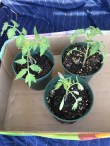 Uncle Pete and Aunt Edith’s “essential travel”. It truly was. We are Southern, and summer does not come in the states south of the Mason-Dixon line until tomato plants are in the ground. That day, April 22, we broke the “stay at home” order, and we returned from Nashville, NC victorious — with 3 tomato plants.
Now there are 2. Why? I’ll never know. Perhaps the one plant succumbed to the stress of breaking the law. Or maybe the 55 minute trip in the back of my SUV was just too much for it’s tender stalk. I attempted to nurse it back to health with plenty of TLC. Miracle Grow was provided, along with sunshine in the day and protection from the cold at night. Even a drink of water spiked with a few drops of ironite didn’t give it the boost it needed to keep on living. It simply failed to thrive like its siblings.
Today was the day the 10 inch tall, very hearty looking other 2 plants were to be moved
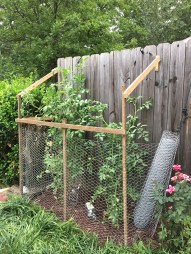
to their permanent summer residence. Last year I constructed a critter-proof tomato cage after we found several fruits, just a day or so from picking, PLUCKED and EATEN. Whether a squirrel, fox or raccoon was the culprit, it didn’t matter. I was determined to make a safe habitat for those and any future tomato plants. I constructed an 8 foot tall 2 X 6 foot frame, then caged it in with chicken wire. It withstood the winter, remaining strong and sturdy.
Now I was poised by the tomato cage, tools and soil enrichment close by, one garden glove on (I lost the other one), and I was prepared to plant! Dad was situated in his chair on the driveway in a supervisory position to instruct me every step of the way.
It went something like this:
- Fold back right side of chicken wire on tomato cage to access the inside; clear and prepare ground for the new plants.
- Step in ant mound. Get both tennis shoes covered with ants. Do a funny dance across the driveway in an attempt to get the ants off of my shoes.
- Note that Dad didn’t notice anything unusual about my high-stepping antics.
- Re-enter the tomato cage with small bow rake to pull back mulch & strands of wire grass out of soil. Uncover Mother Load of ants….and a small snake.
- Do the driveway dance again….and brush off the ones that made it up to my knees. (the snake slithered under the fence to the next yard).
- Position and secure the small electric rototiller at the end of the cage.
- Scatter Black Kow soil conditioner over ground prep area.
- Turn on the rototiller. Underestimate the power of the rototiller’s propulsion.
- Spend the next 15 minutes trying to untangle chicken wire from tiller blades (this was a delicate operation. No wires were cut during the untangle procedure).
- (Note that when you squat down to try and quietly detach tiller blades from chicken wire in an ant mound, and you are wearing shorts, it is a delicate balancing act trying to minimize time on the ground getting eaten alive vs. letting Dad know I had almost ruined his prize tiller. I worked fast and furious).
- Repeat driveway dance for the the third time. Dad moves chair much closer as he suspects some situation is occurring that should not have occurred……..
- Grab Raid ant killer and spray generously around perimeter of where plants will be located.
- Add potting soil onto freshly tilled ground, and work in some of the tilled dirt to
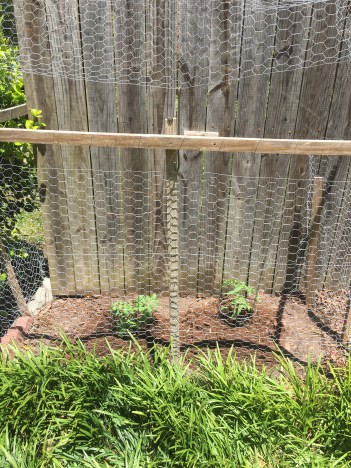 create 2 equal mounds. Pour water in middle of mounds to moisten (Dad said it needed to be hot water, so I obliged). Create holes deep enough so plants will be covered to the bottom set of leaves.
 - Carefully slide tomato plants from plastic pots, loosening roots, and nestle them into the prepared well, back-filling with enough dirt to secure the plant roots and stem.
- Cut 2- 3 inch high rings from the plastic pots, and place them around each plant such that the top of the plastic is visible above the dirt. (This is supposed to prevent cutworms from destroying the plant’s stem).
- Mulch in, place wire tomato-cages over plants for support, water and re-secure chicken wire on cage.
Voila! There you have it! Two tomato plants (rest in peace with Mother Nature, plant #3).
Funny thing is….I don’t even eat tomatoes. If you count ketchup, or if the tomatoes are cooked in sauces, soups or recipes, I love them. But not a freshly sliced tomato on a classic BLT or hamburger.
Daddy LOVES tomatoes. And I love Daddy. Plus, he needs a purpose right now. His back began giving him major problems just a couple of weeks ago. Just before he experienced the first pain, he was able to walk over half a mile every day in the neighborhood using only a cane. Now, using prescribed pain medicine and muscle relaxers, he can barely shuffle down the hallway, struggling to support himself with a walker. However, the tomato plants, newly settled in their protective chicken wire cage, are just a few yards from the back door, and offer an enticing invitation for Dad to take a few more steps, giving him the much needed exercise he needs to heal.
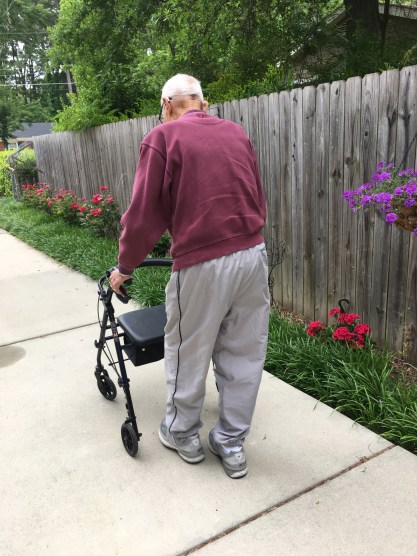 It takes a LOT of effort now for Daddy to stand up and walk. And it hurts me to see him struggle to move even a short distance. But he doesn’t seem to mind. When he makes it outside, his focus is on those two little plants, and walking the 50 steps it takes to reach them. He comments on how much they’ve grown, talks about what a great job “we did” planting them, and (no doubt) can begin to taste the savory, refreshing, juicy fruit they will bear in a few weeks.
And, fingers crossed, Dad’s back will be strong enough by then that he can bend over, without pain, to pick the first one. For me, THAT’s essential!
 Cary to Calcutta